

One Thousand Words
..and the picture of equal value

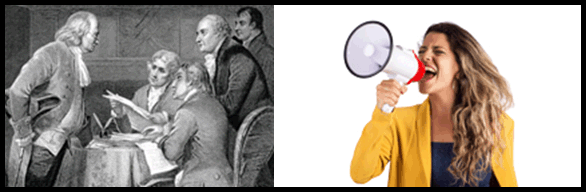
The familiar adage, “A picture is worth a thousand words,” is particularly insightful for authors of any venue. Of course, those “words” are a metaphor for the written or verbal alternative to a pictorial representation of an idea or event. The use of an image is supposed to be all the more useful than words as the idea being explained becomes more complex. Most cartoonists use word clouds and bubbles above the characters to tell us what they are saying or thinking, and even which Zap, Bang, and Swoosh sounds result from the actions portrayed from one frame to the next. Not impossible, but difficult is using only images for a sequence of ideas without embedded bubbles or intervening verbal segways. A picture of a crashed auto followed by a picture of an injured patient in hospital doesn’t need a segway. That is a brute-force example illustrating cause and effect. Here’s another, understood by devotees of free speech. The cause, granting a right, and the effect, exercising it, are widely separated in time and probably place, but the imagery still works.
Extrapolating from this theme, we realize that there is an inquiry method that pollsters might consider. Show respondents a picture of a politician and ask them to choose a second image to follow the first. If the resulting choice for picture number two is the crashed car, that says a great deal. An array of second images from which respondents must choose, however general and well-selected, can’t avoid bias and would certainly not provide the chance for nuanced responses. A blank “other image” choice must be offered with a crayon to facilitate an answer. That answer would require analysis not unlike that applied to Rorschach test images. The additional benefit of this approach would be not only ascertaining an opinion about the politician but being able to categorize the nature of the respondents in terms of personality characteristics and emotional functioning. Scoring the responses without the standard set of inkblots would require a new analytical approach. Such diagnoses as schizophrenia, depression, psychosis, and anxiety would be replaced with nodes on the political spectrum from radical left to radical right. On the off chance that the crayoning reveals tendencies that red-flag laws cover, an appropriate referral could be made.
No doubt, purely pictorial polling with published results, including the psychological categories of those polled, would lead to legal proceedings where many thousands of words that are not substitutable by pictures would arise. What possible defense could be raised? The obvious one, if the sample size were large enough, is that the data contribute to our understanding of the mental health of the voting-age public and learning that one particular candidate for office happens to be the favorite of the sociopathic fringe is a mere side benefit.
Let’s try one example.
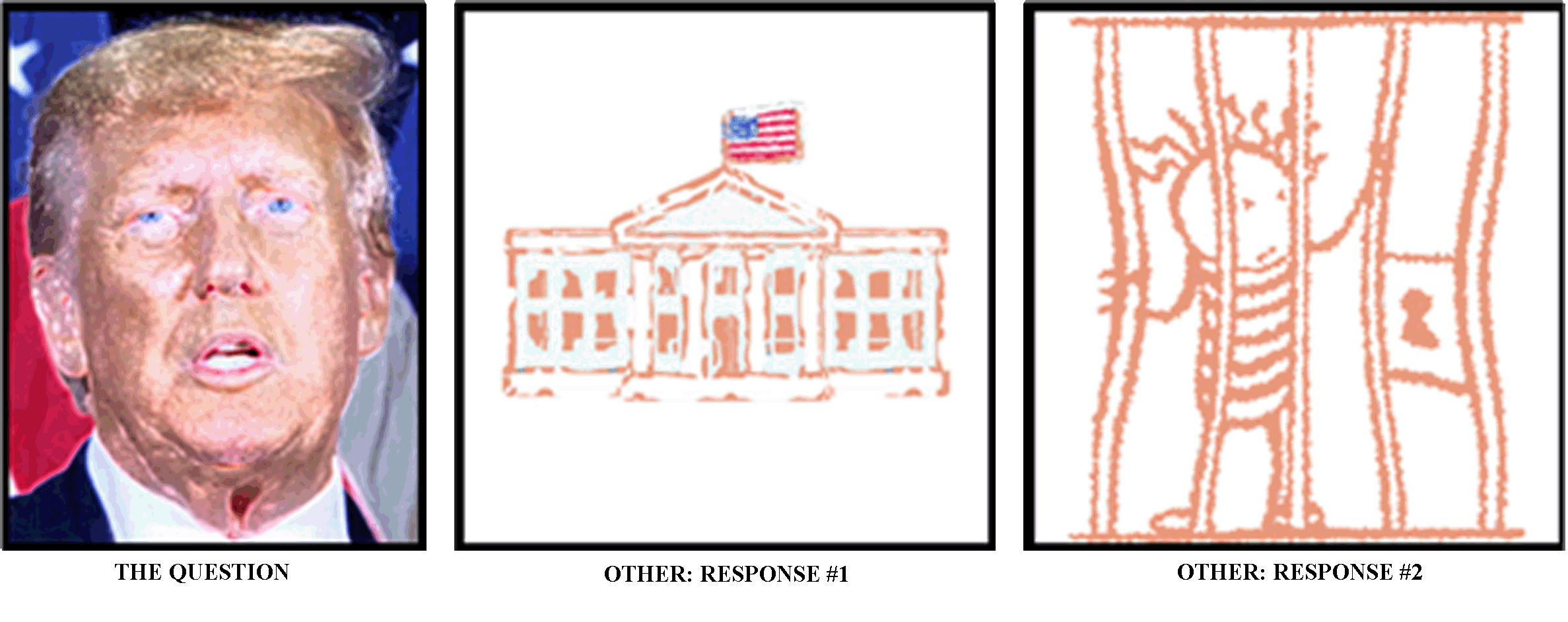
The efficiency of imagery is certainly confirmed here. Clearly, many more than three thousand words have been saved.
My own serious interest in the photographic image dates to about 1986 with a smattering of on-again, off-again forays into the hobby from 1978 onward. Suffice it to say that each image I have composed has spoken to me. Perhaps not a full 1000 words, but enough to infuse enthusiasm for the opportunity to find another scene of interest. Whether any of my images speak to others remains an open question. Over the years, favorite images have fallen into categories that in some way were at least loosely related to a perspective on the human condition and our environs.[*] One category, that of “labor,” is quite transparently related to the lot of often unsung workers. Images of street sweepers dominated that category. “Convergence” and “juxtapositions” categories relied on visual metaphor to make their points. Seeing opposites side-by-side and seeing the way initially distant features come together as they recede toward the horizon equate to “come now, let us reason together…” (Isaiah 1:18). Beyond those, messages, if any, from the other categories are less obvious – i.e., less a push than a pull.
A fun exercise would be jotting down the words equivalent to each image. A free-time diversion for sure, but more than that, as a group activity would it not be a discovery process? Certainly not invasive like inkblots, but at least a basis for dialogue and finding that ever illusive common ground. This seems a simple exercise, and a way to use images, not to replace, but to focus and constrain the verbiage in a way that avoids unproductive tangents and contentious sidebars. The gaping flaw in this otherwise wise idea is that it probably wouldn’t work.
Who has not seen a visitor to an art museum staring pensively at a sculpture or canvas for what seems like forever and wondering what about the objet d’art is so fascinating? If we were to inquire, the patron would likely be at a loss for words. Not one thousand words, but not even one. I suppose the anatomy of the human brain manages visual and verbal inputs and analyses differently. At the root is the question as to whether the emotional responses in each case issue from the same center or are themselves unique and disjoint. Empathy, awe, fear, and hope may well be expressible in neither words nor images.
Conclusion: That picture is not and never has been a substitute for an equivalent thousand words. We have two distinct modes of communication that can reinforce each other but each appeals to a different way of understanding an idea. And there is a third indecipherable component that remains within each of us as incommunicable feelings. Perhaps our emotional reaction to an inkblot is not unlike discovering which museum display captivates. Both unearth a vital aspect of who we are, the aspect beyond words and pictures that ultimately controls whether juxtapositions and convergence ever do let us reason together.
[*] https://www.cycloid-fathom.com/gallery
Disclaimer: Any and all opinions expressed here are my own at the time of writing with no expectation that they will hold beyond my next review of this article. Opinions are like a river, winding hither and yon, encountering obstacles and rapids, and suffering turbulent mixing of silts from its depths and detritus from its banks. But just as a river has its clear headwaters and a fertile delta, so do opinions, notwithstanding any intervening missteps and uncertainties.